
What Are Non-Surgical Treatments for Fibroids?
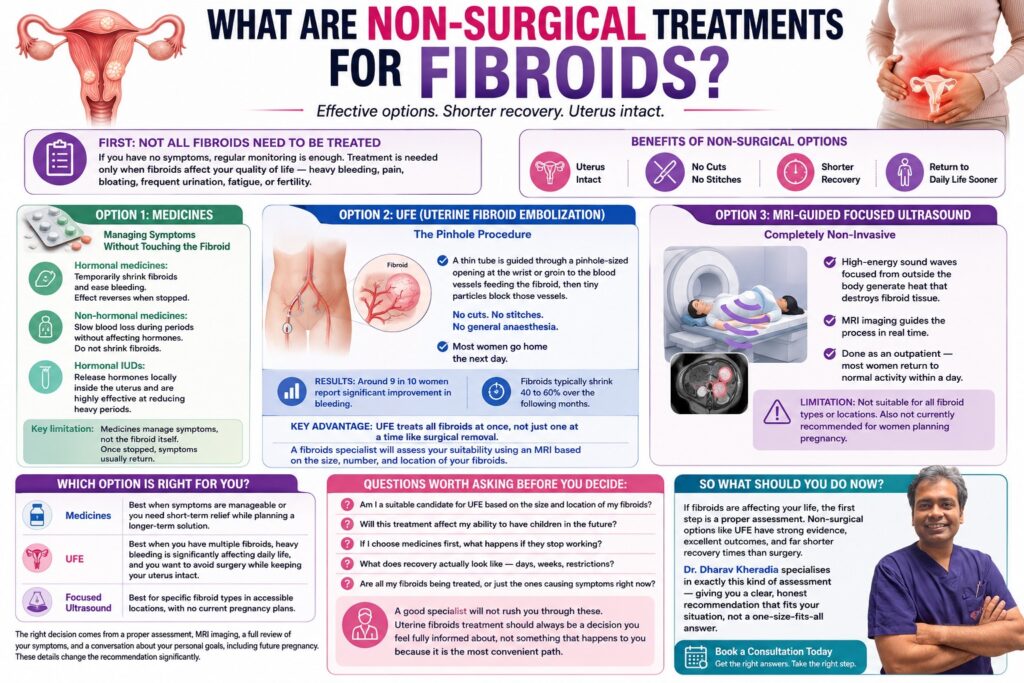
Introduction
For a long time, surgery was the standard answer for fibroids either removing the fibroids (myomectomy) or the uterus entirely (hysterectomy). Many women went through major operations when other options were available but never clearly explained. Today, non-surgical uterine fibroids treatment is a well-established path. This blog breaks down what each option involves, who it suits, and the questions worth asking before you decide.
First: Not All Fibroids Need to Be Treated
Fibroids with no symptoms, no heavy bleeding, no pain, no pressure on daily life do not need treatment. Regular monitoring is completely appropriate. Treatment becomes relevant when fibroids are actively affecting your quality of life: very heavy or prolonged periods, pelvic pain, frequent urination, bloating, fatigue from blood loss, or difficulty getting pregnant.
Option 1: Medicines Managing Symptoms Without Touching the Fibroid
Medicines do not remove fibroids but can control the symptoms that make life difficult, particularly heavy bleeding and pain.
Hormonal medicines: Reduce oestrogen to temporarily shrink fibroids and ease bleeding. The effect reverses when stopped, often used short-term before a planned procedure or to rebuild iron levels after blood loss.
Non-hormonal medicines: Slow blood loss during periods without affecting hormones. They do not shrink fibroids but are helpful when bleeding is the main concern.
Hormonal IUDs: Release hormones locally inside the uterus and are highly effective at reducing heavy periods though not suitable if the fibroid is distorting the uterine cavity.
The key limitation: medicines manage symptoms, not the fibroid itself. Once stopped, symptoms usually return. For a long-term solution, a procedural option is a better fit.
Option 2: UFE (Uterine Fibroid Embolization) The Pinhole Procedure
Uterine Fibroid Embolization is the most widely used non-surgical procedure for fibroids, performed for over 25 years with strong evidence behind it. Leading gynaecology bodies now recommend UFE as an equally effective alternative to surgery for symptom control.
Fibroids need a blood supply to survive. UFE cuts that supply off. A thin tube is guided through a pinhole-sized opening at the wrist or groin to the blood vessels feeding the fibroid, then tiny particles block those vessels. No cuts. No stitches. No general anaesthesia. Most women go home the next day with the uterus completely intact.
Results: around 9 in 10 women report significant improvement in bleeding. Fibroids typically shrink 40 to 60 percent over the following months. Pain and pressure improve alongside.
Key advantage: UFE treats all fibroids at once, not just one at a time like surgical removal. A fibroids specialist will assess your suitability using an MRI based on the size, number, and location of your fibroids.
Option 3: MRI-Guided Focused Ultrasound Completely Non-Invasive
Nothing enters the body at all. High-energy sound waves focused from outside the body generate heat that destroys fibroid tissue, with MRI imaging guiding the process in real time. Done as an outpatient most women return to normal activity within a day.
Limitation: Not suitable for all fibroid types or locations. Also not currently recommended for women planning pregnancy, as long-term fertility data is limited. Discuss with a fibroids specialist to see if this fits your situation.
Which Option Is Right for You?
Medicines: Best when symptoms are manageable or you need short-term relief while planning a longer-term solution.
UFE: Best when you have multiple fibroids, heavy bleeding is significantly affecting daily life, and you want to avoid surgery while keeping your uterus intact.
Focused ultrasound: Best for specific fibroid types in accessible locations, with no current pregnancy plans.
The right decision comes from a proper assessment, MRI imaging, a full review of your symptoms, and a conversation about your personal goals, including future pregnancy. These details change the recommendation significantly.
Questions Worth Asking Before You Decide:
Am I a suitable candidate for UFE based on the size and location of my fibroids?
- Will this treatment affect my ability to have children in the future?
- If I choose medicines first, what happens if they stop working?
- What does recovery actually look like days, weeks, restrictions?
- Are all my fibroids being treated, or just the ones causing symptoms right now?
A good specialist will not rush you through these. Uterine fibroids treatment should always be a decision you feel fully informed about, not something that happens to you because it is the most convenient path.
So What Should You Do Now?
If fibroids are affecting your life, heavy periods, pelvic discomfort, fatigue, or the constant worry of not knowing the first step is a proper assessment. Non-surgical options like UFE have strong evidence, excellent outcomes, and far shorter recovery times than surgery. Whether they are right for you depends on your MRI, your symptoms, and your goals. Dr. Dharav Kheradia specialises in exactly this kind of assessment giving you a clear, honest recommendation that fits your situation, not a one-size-fits-all answer.