
Spider Veins vs Varicose Veins: What's the Real Difference?
Introduction
They’re not the same thing and mixing them up can lead to the wrong treatment decision.Most people use these two terms as if they mean the same thing. They don’t and understanding the difference matters, because treating one when you actually have the other is a very common reason vein treatment doesn’t fully work.
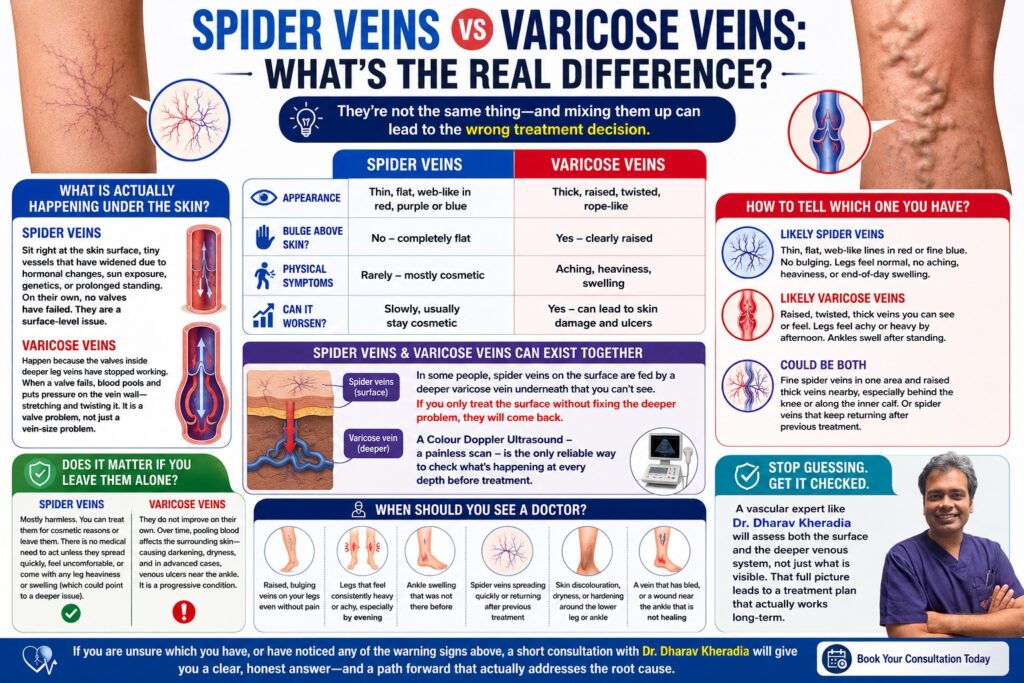
At a Glance: How They Compare:
| Spider Veins | Varicose Veins |
|---|---|---|
Appearance | Thin, flat, web-like in red, purple or blue | Thick, raised, twisted, rope-like |
Bulge above skin? | No completely flat | Yes clearly raised |
Physical symptoms | Rarely mostly cosmetic | Aching, heaviness, swelling |
Can it worsen? | Slowly, usually stay cosmetic | Yes can lead to skin damage and ulcers |
What Is Actually Happening Under the Skin?
Spider veins sit right at the skin surface, tiny vessels that have widened due to hormonal changes, sun exposure, genetics, or prolonged standing. On their own, no valves have failed. They are a surface-level issue.
Varicose veins are different. They happen because the valves inside deeper leg veins have stopped working. Healthy valves let blood flow upward toward the heart, then close to stop it falling back. When a valve fails, blood pools and puts pressure on the vein wall stretching and twisting it. That is why varicose veins look the way they do. It is a valve problem, not just a vein-size problem.
The Part Most People Get Wrong:
Spider veins and varicose veins can exist together and this is where most treatment mistakes happen. In some people, the spider veins on the surface are being fed by a deeper varicose vein underneath that you cannot see from the outside.
Think of it like a cracked water pipe behind a wall. The damp patches on the wall are the spider veins visible, but caused by the hidden crack below. If you only paint over the patches without fixing the pipe, they will come back. This is exactly why spider veins return after treatment when a deeper varicose veins feeding them was never addressed. A Colour Doppler Ultrasound a painless scan is the only reliable way to check what is happening at every depth before treatment.
How to Tell Which One You Have?
Likely spider veins: Thin, flat, web-like lines in red or fine blue. No bulging. Legs feel normal, no aching, heaviness, or end-of-day swelling.
Likely varicose veins: Raised, twisted, thick veins you can see or feel. Legs feel achy or heavy by afternoon. Ankles swell after standing. Some discomfort around the vein area.
Could be both: Fine spider veins in one area and raised thick veins nearby, especially behind the knee or along the inner calf. Or spider veins that keep returning after previous treatment.
Does It Matter if You Leave Them Alone?
Spider veins: Mostly harmless. You can treat them for cosmetic reasons or leave them there is no medical need to act unless they spread quickly, feel uncomfortable, or come with any leg heaviness or swelling (which could point to a deeper issue).
Varicose veins: They do not improve on their own. Over time, pooling blood affects the surrounding skin causing darkening, dryness, and in advanced cases, venous ulcers near the ankle. None of this happens overnight, but it is a progressive condition. Early assessment with a varicose veins specialist makes treatment far simpler and more effective.
When Should You See a Doctor?
You do not need a doctor for every spider vein. But book an appointment if you notice:
- Raised, bulging veins on your legs even without pain
- Legs that feel consistently heavy or achy, especially by evening
- Ankle swelling that was not there before
- Spider veins spreading quickly or returning after previous treatment
- Skin discolouration, dryness, or hardening around the lower leg or ankle
- A vein that has bled, or a wound near the ankle that is not healing
A vascular expert like Dr. Dharav Kheradia will assess both the surface and the deeper venous system, not just what is visible. That full picture is what leads to a treatment plan that actually works long-term.
Stop Guessing Get It Checked
Spider veins are mostly a cosmetic concern. Varicose veins are a progressive medical condition involving failed vein valves. In some people, both exist together which is why a proper scan before any treatment is essential, not optional. If you are unsure which you have, or have noticed any of the warning signs above, a short consultation with Dr. Dharav Kheradia will give you a clear, honest answer and a path forward that actually addresses the root cause.