
What Shoes Should Diabetic Patients Wear to Avoid Foot Problems?
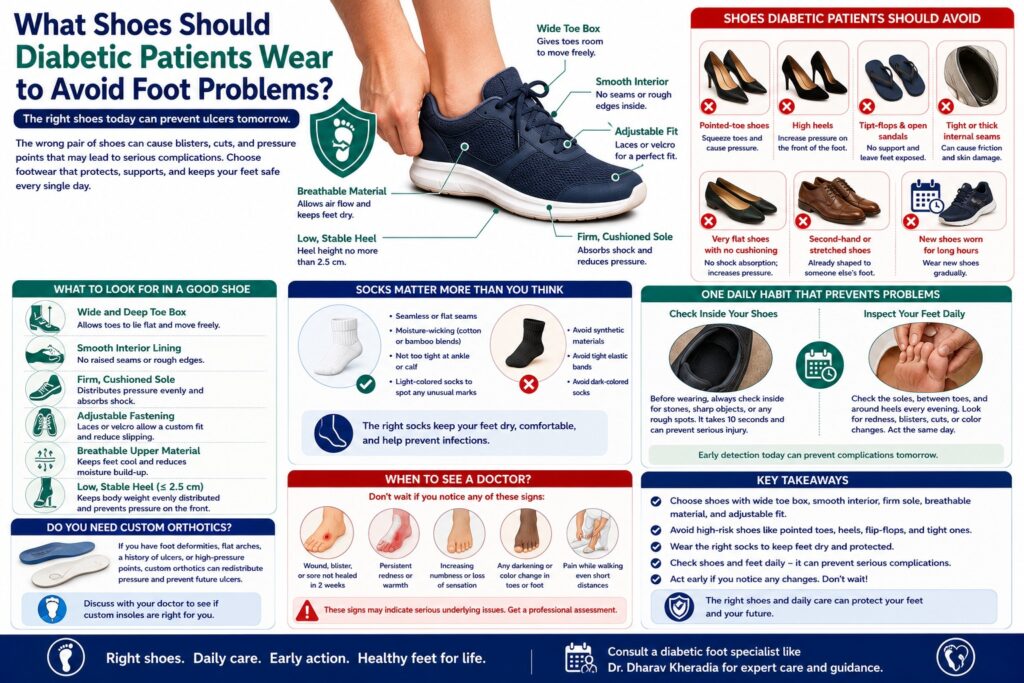
Introduction
Most people pick shoes based on comfort, style, or price. For someone with diabetes, that approach can quietly cause serious harm. The wrong pair of shoes even a slightly tight one can create a pressure point, a blister, or a small cut. In a healthy person, that heals in a few days. In a diabetic patient, that same minor injury can spiral into an ulcer, an infection, or worse.
This blog is specifically about footwear what to look for, what to avoid, and why getting this one daily decision right is one of the most practical things a diabetic patient can do for their long-term foot health.
Why the Wrong Shoes Are Riskier for Diabetic Patients Than Anyone Else?
Diabetes affects two things that make feet especially vulnerable: nerve sensation and blood circulation. Reduced nerve sensitivity means a patient may not feel a shoe rubbing, a seam pressing, or a stone stuck inside injuries that a non-diabetic person would notice and fix immediately. Poor circulation means that even minor skin damage takes far longer to heal, creating an open window for infection.
This combination makes footwear choices a genuine medical concern not just a comfort preference. A shoe that is even slightly wrong in fit, material, or structure can set off a chain of events that leads to a diabetic foot wound requiring medical attention. The good news is that the right pair of shoes, chosen carefully, dramatically reduces that risk.
What to Look for in a Good Shoe?
You don’t need to buy an expensive or medically labelled shoe to protect your feet well. What matters is the specific features. Look for all of the following:
Wide and deep toe box.
Your toes should be able to lie flat without touching the front or sides. Shoes that squeeze the toes together even slightly create pressure points that can lead to blisters and calluses. If your little toe or big toe is pressing against the shoe at any point, it does not fit correctly.
Smooth interior lining with no raised seams.
Interior seams may seem harmless, but against skin with reduced sensation, they can cause repetitive friction injuries that go unnoticed for days. Run your hand inside the shoe before buying the lining should feel uniformly smooth.
Firm, cushioned sole.
A thick, shock-absorbing sole distributes body weight evenly across the foot. This prevents high-pressure areas forming under the heel or ball of the foot spots where ulcers commonly begin in diabetic patients.
Adjustable fastening laces or velcro.
Slip-on shoes and tight elastic openings are convenient but difficult to adjust properly. Laces or velcro straps allow you to fine-tune the fit each time, which matters especially if your feet swell at different times of day.
Breathable upper material.
Leather or mesh uppers allow airflow, which reduces moisture build-up. Damp, warm environments inside poorly ventilated shoes encourage fungal infections a risk that is significantly higher in people with diabetes.
Low, stable heel no higher than 2.5 cm.
High heels shift body weight onto the front of the foot, concentrating pressure in exactly the areas most prone to ulcer formation. A low, wide heel keeps weight evenly distributed.
Shoes That Diabetic Patients Should Strictly Avoid:
Just as important as knowing what to look for is knowing what to stay away from. The following types of footwear are high-risk for diabetic patients and should be avoided entirely:
- Pointed-toe shoes — They force the toes into an unnatural position, creating pressure on joints and skin
- High heels — They overload the ball of the foot with every step
- Flip-flops and open sandals — They offer no structure, leave the foot exposed to injury, and the toe grip causes abnormal pressure on the toes
- Shoes with tight or thick internal seams — Even brief contact can break down skin
- Very flat shoes with no sole cushioning (like ballet flats) — They provide no shock absorption and can increase pressure under the heel and arch
- Second-hand or stretched shoes — They have already shaped to someone else’s foot and will create pressure in the wrong places on yours
- New shoes worn for long periods straight away — Any new shoe needs a break-in period; diabetic patients should introduce new footwear gradually, starting with 1–2 hours per day
Socks Matter More Than Most People Think:
The right shoe paired with the wrong sock can still cause problems. Diabetic patients should look for socks that are seamless (or have flat seams), made from moisture-wicking materials like cotton or bamboo blends, and not too tight at the ankle or calf. Socks with tight elastic bands restrict circulation the opposite of what a diabetic foot needs.
Avoid synthetic materials that trap heat and moisture. Dark-coloured socks can also hide small bleeds or discharge from wounds white or light-coloured socks are a better daily choice for someone managing diabetic foot health, since any unusual marks are easier to spot.
One Daily Habit That Prevents More Problems Than Any Shoe Can:
Before putting on shoes every single morning, run your hand inside each one. Feel for small stones, hard debris, a folded insole, or any rough patch in the lining. This takes ten seconds and prevents the kind of injury that diabetic patients genuinely cannot afford a sharp object pressing against a foot that can’t feel pain properly.
Similarly, inspect your feet every evening. Look at the soles, between the toes, and around the heels. Use a mirror or ask a family member if bending down is difficult. Any new redness, blister, cut, or discolouration needs attention the same day not a week later. A specialist in diabetic foot management, like Dr. Dharav Kheradia, will always tell you that early detection of foot changes is what separates a quick fix from a serious complication.
Do Diabetic Patients Need Custom Orthotics?
Not everyone does, but for patients with foot deformities, flat arches, a history of ulcers, or uneven weight distribution, custom-made insoles can be genuinely important. They redistribute pressure away from vulnerable areas and are shaped precisely to your foot something no off-the-shelf insole can replicate.
If you’ve ever had a diabetic foot ulcer or been told you have high-pressure points on your feet, it’s worth discussing custom orthotics with your doctor. They can be fitted into your existing footwear and make a significant difference to long-term protection.
When Good Footwear Isn't Enough Knowing When to See a Doctor
Proper footwear reduces risk significantly, but it doesn’t eliminate it entirely especially if diabetes has already affected your circulation or nerve function. If you notice any of the following despite wearing appropriate shoes, it’s time to get a proper medical assessment:
- A wound, blister, or sore that hasn’t healed within 2 weeks
- Persistent redness or warmth in one area of the foot
- Increasing numbness or loss of sensation spreading upward
- Any darkening or colour change in the toes or foot
- Pain while walking even short distances this can signal reduced blood flow to the foot
These signs point to underlying vascular or nerve changes that no shoe can fix. At that stage, an assessment from a diabetic foot management specialist is the right next step the sooner, the better.
Key Takeaways
For diabetic patients, a shoe is not just a shoe. It’s a daily decision that either protects the feet or quietly puts them at risk. The right choice doesn’t need to be expensive or medicalized it just needs to tick the right boxes: wide toe box, smooth interior, firm cushioned sole, breathable material, and a proper fit bought at the right time of day.
Pair that with daily foot checks, the right socks, and a willingness to act quickly on any change you notice and you’re doing more for your foot health than most people realise is possible through daily habits alone. And if something doesn’t look right, don’t wait. A conversation with a diabetic foot expert like Dr. Dharav Kheradia takes far less time than treating a complication that was allowed to develop.