
When Should I Worry About Varicose Veins?
Introduction
Most people with varicose veins do the same thing they notice them, feel mildly concerned, and then quietly decide to keep an eye on things. That approach is fine for a while. But there comes a point where “keeping an eye on it” starts working against you.
What we want to talk about here is the part most people actually struggle with: knowing when their veins have crossed from a cosmetic annoyance into something that genuinely needs attention.
The "I'll Deal With It Later" Thing:
Varicose veins are slow-moving. They don’t suddenly worsen overnight, which makes it very easy to keep postponing a check-up. The problem is that the complications they cause skin damage, ulcers, clotting also develop slowly and quietly. By the time symptoms become impossible to ignore, the condition is often at a stage where treatment is more involved than it would have been earlier.
The sweet spot for getting help is actually when symptoms are mild not when they’re severe. Early-stage varicose veins treatment is faster, less invasive, and more effective. Waiting doesn’t buy you time; it just reduces your options.
Cosmetic Concern vs Medical Problem - How to Tell the Difference?
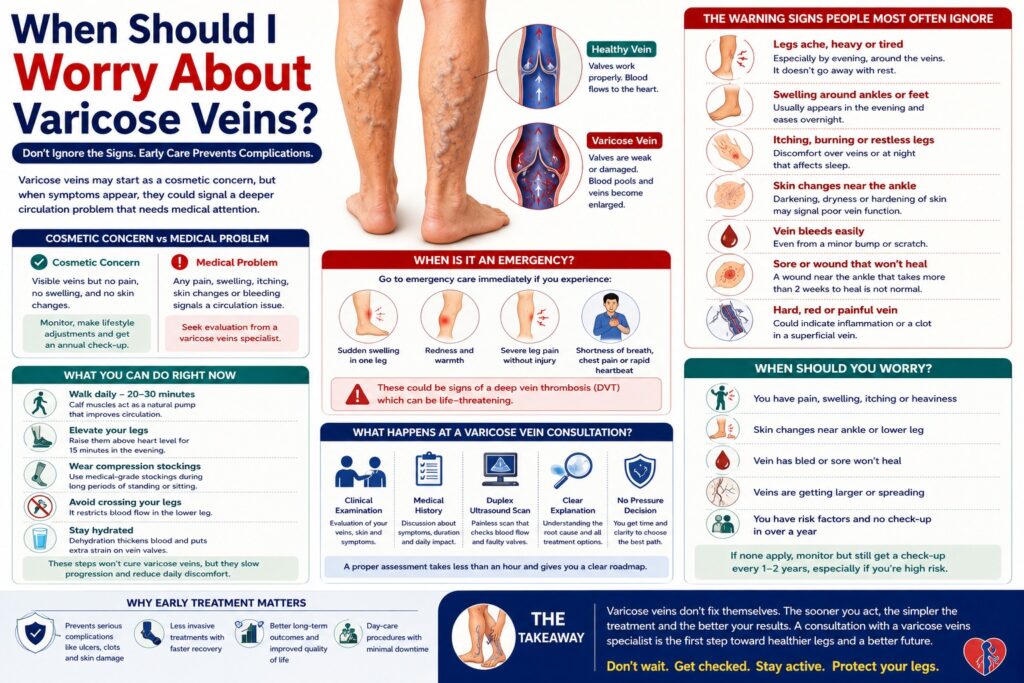
Not all varicose veins need treatment. If your veins are visible but cause you no discomfort, no swelling, and no skin changes they’re most likely a cosmetic concern right now. You can monitor them, make lifestyle adjustments, and revisit with a vascular expert annually.
However, the line between cosmetic and medical shifts once any of the following appear:
- Legs that feel heavy, achy, or tired by mid-afternoon even on days when you haven’t done much
- Swelling around the ankles or feet that appears towards evening and eases overnight
- Itching or a burning sensation directly over a vein
- Skin around the ankle that looks darker, dryer, or feels harder than the rest of your leg
- A vein that bleeds easily even from a minor graze or bump
- Restless legs at night that interrupt your sleep
Any one of these signals that your veins are affecting circulation, not just appearance. At that point, a proper clinical assessment is the right move not more waiting.
The Warning Signs People Most Often Ignore:
Some symptoms are easy to dismiss because they feel minor or come with an obvious explanation. Here are the ones a varicose veins specialist sees most often in patients who waited too long:
“My legs just ache because I stand all day.”
Leg ache from standing is normal. Leg ache that persists into the evening and is concentrated around visible veins is not. Chronic venous aching is different from muscle fatigue it doesn’t go away with rest the way tired muscles do.
“A little skin darkening near my ankle must be dry skin.”
Skin discolouration around the lower leg or ankle that gradually deepens is a recognised sign of chronic venous insufficiency. It means blood has been pooling long enough to damage the surrounding tissue. This stage needs evaluation, not moisturiser.
“There’s a small sore near my ankle that’s slow to heal.”
A wound near the ankle that takes more than two weeks to heal or keeps reopening may be a venous ulcer. This is one of the more serious complications of untreated varicose veins and should be seen by a vascular expert without delay.
“One section of vein feels hard and sore to touch.”
Hardness, redness, and localised pain along a vein can indicate superficial thrombophlebitis inflammation caused by a small clot within the vein. It’s not the same as a deep vein clot, but it still requires prompt medical review.
When Is It an Emergency? Understanding DVT Risk
Varicose veins themselves rarely cause a medical emergency, but significant untreated venous disease can raise the risk of deep vein thrombosis (DVT) a clot in the deeper leg veins. Unlike superficial vein problems, DVT can be dangerous if the clot travels to the lungs.
Go to emergency care immediately if you experience:
- Sudden swelling in one leg that develops quickly not the usual evening swelling
- Redness and warmth along the inner thigh or calf
- Severe leg pain that started without injury
- Shortness of breath, chest pain, or rapid heartbeat alongside leg symptoms
These symptoms are rare in people with straightforward varicose veins, but they’re important to know. The good news: routine varicose veins treatment significantly reduces the likelihood of reaching this point.
What You Can Do Right Now (While You Plan a Consultation)
If you’re in the “monitoring” phase, a few daily habits genuinely slow down the progression of varicose veins:
- Walk for at least 20–30 minutes daily your calf muscles act as a natural pump that pushes blood back up toward the heart
- Elevate your legs above heart level for 15 minutes in the evening simple and effective for reducing end-of-day swelling
- Wear medical-grade compression stockings during long periods of standing or sitting
- Avoid crossing your legs for extended periods it restricts circulation in the lower leg
- Stay hydrated dehydration thickens the blood slightly, which adds strain on vein valves
These steps are supportive, not curative. They won’t reverse existing varicose veins but they can meaningfully slow the rate at which new ones form and reduce daily discomfort while you decide on next steps.
What Actually Happens at a Varicose Vein Consultation?
A lot of people put off booking an appointment because they’re not sure what to expect or they assume it will immediately lead to a procedure. It doesn’t work that way.
A standard first consultation with a varicose veins specialist involves:
- A clinical examination of your legs looking at the size, location, and pattern of the veins
- A conversation about your symptoms, how long you’ve had them, and how they affect your daily life
- A duplex ultrasound scan a painless, non-invasive scan that maps blood flow in your veins and identifies any faulty valves that aren’t visible on the surface
- A clear explanation of what’s found and what your options are with no pressure to decide on the day
The ultrasound is what makes modern vascular assessment so much more accurate than a visual check alone. It’s what allows a specialist like Dr. Dharav Kheradia to identify the root cause of your veins not just what’s visible and recommend a treatment plan that actually addresses the source of the problem rather than just the surface appearance.
When Is the Right Time to Worry?
Worry isn’t quite the right word. Awareness is better. You should move from passive awareness to active follow-up when:
- Your varicose veins are causing any physical symptom aching, swelling, itching, heaviness
- You notice any skin changes near your ankle or lower leg
- A vein has bled, or there’s a sore that won’t heal
- Your veins are visibly getting larger or spreading over time
- You have multiple risk factors and haven’t had a check-up in over a year
If none of the above apply, you’re likely fine to monitor but still worth a check with a vascular expert every year or two, especially if your veins are prominent or you’re in a high-risk group.
The Takeaway
Varicose veins are one of those conditions where timing genuinely matters. They don’t fix themselves, and the longer significant venous insufficiency goes untreated, the more impact it has on the surrounding skin and tissue. The reassuring part is that modern varicose veins treatment is quick, well-tolerated, and done as a day procedure meaning the barrier to getting help is much lower than most people assume.
If you’ve been sitting on the fence, let this be the nudge to book that first consultation. A proper assessment with Dr. Dharav Kheradia takes less than an hour, tells you exactly what’s going on, and gives you a clear picture of whether treatment is needed at all and if it is, what the simplest path forward looks like.