
5 Medical Problems That Can Be Treated Without Major Surgery
Introduction: The Rise of Minimally Invasive Vascular Care
Modern medicine has crossed a remarkable threshold. Conditions that once demanded lengthy open surgeries with large incisions, general anaesthesia, and months of rehabilitation can now be treated through access points smaller than a pencil tip. For patients with vascular disease, this shift is not just convenient. In many cases, it is life-changing.
Why Surgeons Are Reaching for Catheters Instead of Scalpels
Advances in real-time imaging, catheter technology, and interventional techniques have given vascular specialists the ability to work inside the body’s blood vessels without ever opening them surgically. Guided by live X-ray, ultrasound, or MRI, a thin flexible tube a catheter can be navigated through the arterial system to deliver stents, dissolve clots, seal vessels, or reinforce weakened walls from within.
Who Benefits Most From Non-Surgical Vascular Treatment?
Minimally invasive vascular procedures
Minimally invasive vascular procedures benefit a broad range of patients including elderly individuals, those with heart or lung conditions, and patients who are not candidates for traditional open surgery. If you or a loved one has been told you have a vascular condition, it is worth asking whether a non-surgical option exists.
Here are five serious medical problems now routinely treated without major surgery.
Blocked Arteries (Peripheral Artery Disease) - Treated With Angioplasty & Stenting
What Happens When Arteries Get Blocked?
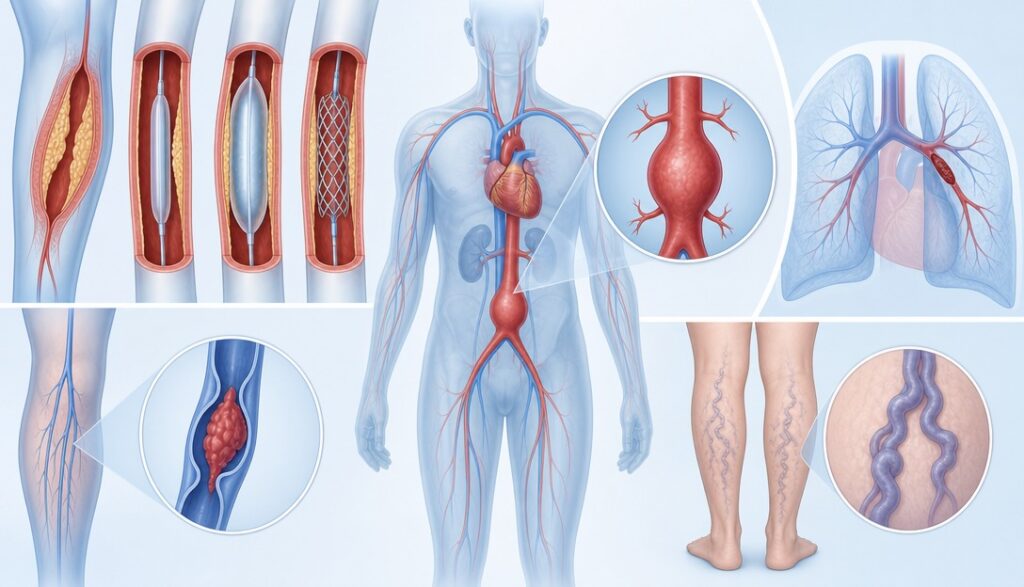
Peripheral artery disease (PAD) occurs when plaque builds up inside the arteries that supply blood to the legs, arms, or organs. As the arteries narrow, blood flow is reduced causing leg pain during walking, slow-healing wounds, numbness, and in severe cases, tissue death or limb loss. PAD affects millions of people worldwide and is strongly linked to diabetes, smoking, and high cholesterol.
How Balloon Angioplasty Opens Arteries Without a Single Cut
Rather than surgically bypassing the blocked artery, vascular specialists use balloon angioplasty a catheter with a small balloon at its tip, inserted through a puncture at the wrist or groin. The balloon is inflated at the blockage site to widen the artery. A mesh stent is then placed to keep the artery open permanently. The procedure typically takes less than two hours, requires no general anaesthesia, and most patients return home the same day.
Aortic Aneurysm - Repaired With EVAR (No Open Abdomen Required)
Why an Aortic Aneurysm Is a Silent Emergency
The aorta is the body’s largest artery, carrying blood from the heart to the rest of the body. An aortic aneurysm is a dangerous bulge in the aortic wall that can grow silently for years until it ruptures. A ruptured aortic aneurysm is a medical emergency with a high fatality rate. Early detection and treatment are critical.
How EVAR Seals the Aneurysm From the Inside Out
Endovascular Aneurysm Repair (EVAR) is a breakthrough procedure that eliminates the need to open the abdomen. A stent-graft a fabric tube supported by a metal framework is delivered through catheters inserted at the groin and guided to the aneurysm site. Once deployed, it lines the weakened aorta from within, redirecting blood flow safely and preventing rupture. Patients are typically discharged within one to two days and recover fully within weeks, not months.
Dangerous Blood Clots (DVT & PE) - Dissolved With Catheter-Directed Thrombolysis
The Life-Threatening Risk of Untreated Blood Clots
Deep vein thrombosis (DVT) occurs when a blood clot forms in a deep vein most commonly in the leg. If a piece of that clot breaks away and travels to the lungs, it becomes a pulmonary embolism (PE) a potentially fatal event. Blood clots require prompt, targeted treatment to prevent serious complications.
How Thrombolysis Targets Clots Precisely Without Surgery
Catheter-directed thrombolysis delivers clot-dissolving medication directly to the clot site through a catheter positioned precisely within the affected vessel. This targeted approach works faster and more effectively than systemic medication delivered through an IV, and avoids the trauma of surgical clot removal. For large or high-risk clots, this technique can be life-saving with a recovery measured in days.
Varicose Veins - Eliminated With Laser or Radiofrequency Ablation
More Than a Cosmetic Problem: The Real Health Impact of Varicose Veins
Varicose veins are not simply a visual concern. Twisted, enlarged veins in the legs can cause significant pain, swelling, skin changes, and in advanced cases, venous ulcers that are difficult to heal. Left untreated, they can worsen over time and impact daily quality of life.
How Endovenous Ablation Seals Veins Shut Without Stripping
Traditional varicose veins treatment involved physically stripping the vein from the leg a painful procedure with a long recovery. Today, endovenous laser ablation (EVLA) and radiofrequency ablation (RFA) use heat energy delivered through a thin fibre inserted into the vein under local anaesthesia. The heat seals the vein shut from the inside. The body naturally redirects blood to healthy veins. Patients walk in, walk out, and are back to normal activity within days.
Carotid Artery Disease - Treated With Carotid Artery Stenting (CAS)
How Carotid Artery Blockage Raises Your Stroke Risk
The carotid arteries run along both sides of the neck, supplying blood to the brain. When plaque builds up and narrows these arteries, the risk of stroke increases significantly. Carotid artery disease is one of the leading preventable causes of stroke and early treatment is essential.
Stenting vs. Surgery: Why Many Patients Now Choose the Catheter Route
Carotid endarterectomy the traditional surgical approach involves making an incision in the neck to physically remove plaque from the artery. Carotid artery stenting (CAS) offers an alternative: a catheter-delivered stent is placed inside the narrowed artery to hold it open and restore blood flow, without a neck incision. CAS is particularly preferred for patients at high surgical risk, offering comparable stroke prevention with shorter recovery and fewer procedural risks.
What These 5 Treatments Have in Common - And What It Means for You
Shorter Recovery, Lower Risk, Same Results
Each of these five procedures shares a common foundation: tiny access points, real-time imaging guidance, and outcomes that match or exceed those of open surgery with a fraction of the recovery time. Patients experience less pain, less blood loss, fewer complications, and faster return to their normal lives.
How to Know If You’re a Candidate for Minimally Invasive Vascular Care
Not every patient or every condition is suited for a minimally invasive approach anatomy, disease severity, and overall health all play a role. The most important step is a consultation with a qualified vascular specialist who can evaluate your individual case.
Questions worth asking at your next appointment:
- Is there a non-surgical option for my vascular condition?
- How does the minimally invasive approach compare in terms of long-term outcomes?
- What is the typical recovery timeline for this procedure?
- Am I a suitable candidate given my age and health history?
Major surgery is no longer the only answer to serious vascular disease. With the right specialist and the right technology, many life-threatening conditions can now be treated safely, precisely, and without a scalpel.